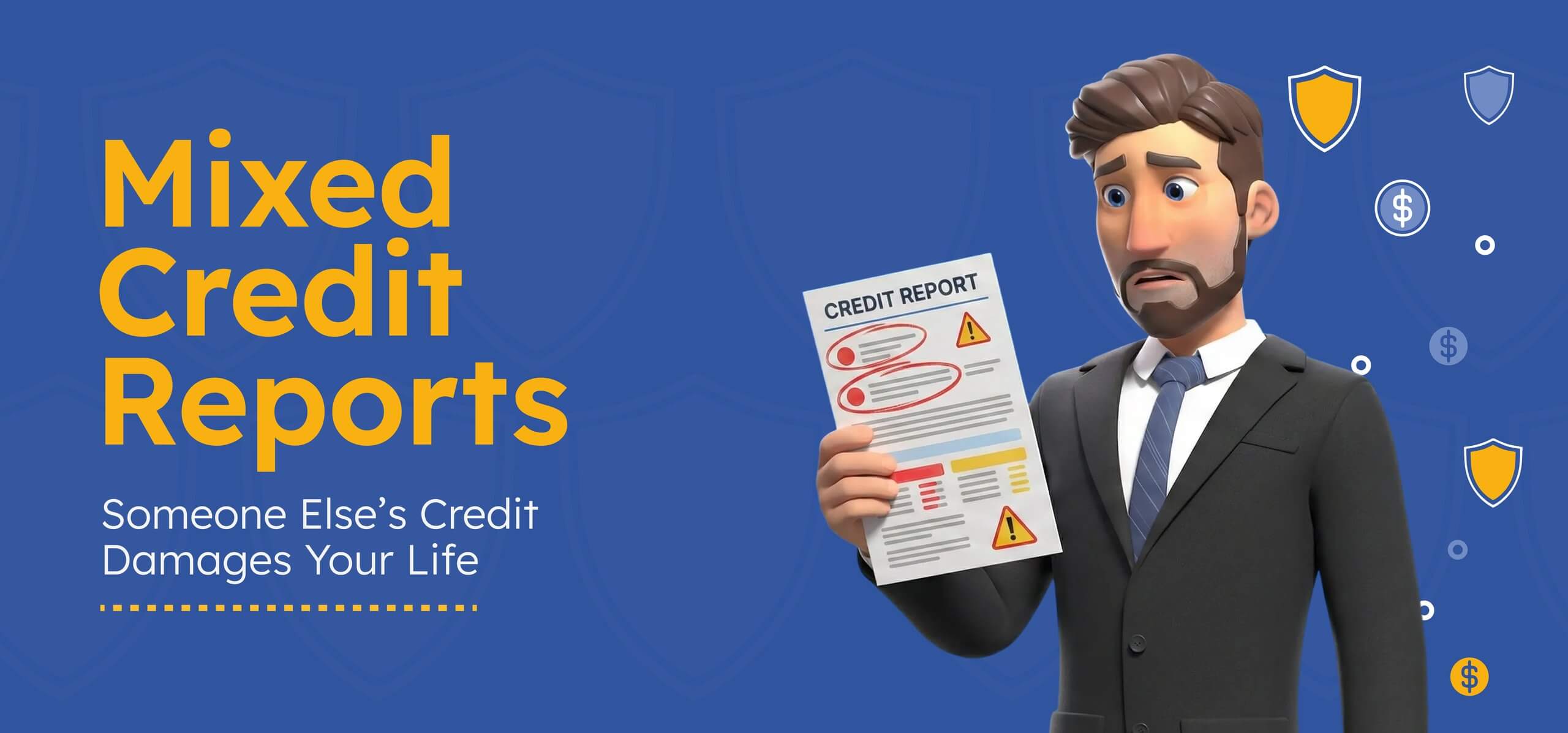
Mixed Credit Reports
-

your file contains someone else’s accounts or public records
-
the credit bureau confuses you with a person who has a similar name, address, or Social Security number
-
your identity gets “blended” with a relative, roommate, or stranger
-

surprise denials for mortgages, auto loans, or credit cards
-
job offers withdrawn after a background or credit check
-
rental applications rejected
-
higher insurance rates or security deposits

-
You see accounts, loans, or credit cards on your report that you never opened.
-
Your report lists addresses, employers, or names you don’t recognize.
-
You’re told you have a bankruptcy, judgment, or serious delinquency that you know nothing about.
-
Your credit score suddenly drops, even though you’ve been paying everything on time.
-
You share a name (or family address) with someone who has serious credit problems.
-
You’ve disputed the errors, but the credit bureaus keep “verifying” them as correct.

 Call (888) 479-9379
-
The Career Block. Michael applies for a senior position that requires a clean financial background. The employer runs a credit check and finds a recent bankruptcy and multiple charged-off accounts. Michael has never filed for bankruptcy. The credit bureau mixed his file with another “Michael Johnson” who lives in a nearby town. The job offer disappears.
-
The Mortgage Meltdown. Sophia and her partner apply for a mortgage. They’re confident: good income, strong savings, no missed payments. The lender calls back with bad news: Sophia’s credit report shows old collections, late payments, and an auto repossession she never had. A stranger’s debts ended up on her file, and the lender now sees her as “high risk.”
-
The Ghost Identity. Rahil shares a similar name with his brother. Over the years, their credit information slowly blended together. When Rahil pulls his report, it looks like one person with two lives — his own good history plus his brother’s financial mistakes. Lenders can’t tell who is who, and Rahil’s applications keep getting denied.
-
1
Get full credit files from all three major credit bureaus.
-
2
Identify exactly which accounts and records belong to someone else.
-
3
Use the FCRA and related laws to force proper investigations and corrections.
-
4
File lawsuits when credit bureaus and furnishers refuse to fix the errors.
-
5
Seek both clean reports and compensation for the damage done.
-

Matching shortcuts
Instead of matching you with perfect precision, some systems rely on combinations of name, partial Social Security number, date of birth, and address. If you share enough details with someone else — or if a digit is mistyped — their data can land in your file.
-
Common names and shared addresses
If your last name is common or you come from a large family that shares addresses over time, the risk goes up. Siblings, parents, and children can have their data tangled together.
-
Data entry and coding errors
A single mis-keyed number or name can send an account to the wrong file. Once it’s in there, automated systems may keep spreading that error across different reports.
-
Bulk public records
Bureaus often buy public-record data in bulk (court records, judgments, bankruptcies). Matching those to the correct person is complex — and mistakes are common.
-
Poor dispute handling
Even when consumers point out obvious mix-ups, bureaus may rely on automated dispute systems that ask the furnisher (like a bank or collector) to quickly click “verified” or “updated.” That’s often not enough to truly separate two blended identities.
-
1
Someone else’s accounts on your report
-
 Credit cards, auto loans, or personal loans you never opened.
-
Collections and charge-offs tied to debts you never owed.
-
Lines of credit and store cards from places you’ve never shopped.
-
-
2
Wrong public records
-
Bankruptcies you never filed.
-
Judgments or tax liens that belong to someone else.
-
Criminal or civil court records linked to your name by mistake.
-
-
3
Blended personal information
-
Multiple middle initials, name spellings, or surnames you’ve never used.
-
Addresses where you never lived.
-
Employers you never worked for.
-
-
4
Mixed files and identity theft overlap
-
True identity theft (someone used your information to open accounts) combined with mixed-file errors (bureaus merging data from more than one person), creating a confusing, messy file.
-
-
5
Failed disputes
-
Credit bureaus repeatedly “verify” the wrong information after superficial investigations.
-
Temporary corrections that later revert back to the wrong data.
-
Multiple dispute cycles with no lasting fix.
-
-
Credit and loans
Higher interest rates, outright denials, or demands for bigger down payments and deposits.
-
Housing
Rental applications rejected or delayed because landlords see you as too risky.
-
Employment
Job offers withdrawn or promotions blocked when employers see red flags on background or credit checks.
-
Insurance
Auto, renters, and homeowners insurance may cost more or be denied altogether if your report makes you look high-risk.
-
Everyday peace of mind
Living with someone else’s debt and legal history stuck to your name is exhausting. Many people feel embarrassed, angry, or constantly on edge — especially when they’ve worked hard to build good credit.
-
Accurate reports
Consumer reports must be as accurate and complete as reasonably possible. Mixed files, by definition, violate this standard.
-
Notice of adverse action
If you’re denied credit, housing, insurance, or a job based on a report, the company must tell you and identify the CRA that supplied the information.
-
Access to your information
You can request copies of your credit reports (and many specialty reports) to see what’s being reported about you.
-
Dispute and investigation
You can dispute information that is inaccurate, incomplete, outdated, or not yours. Credit bureaus and, in many cases, furnishers must conduct a reasonable investigation — not just rubber-stamp the error.
-
Correction or deletion
If information is found to be mixed, inaccurate, or unverifiable, it generally must be corrected or removed — not left on your report.
-
Compensation
If a credit bureau or furnisher willfully or negligently violates the FCRA, you may be entitled to actual damages (including emotional distress), statutory damages in some cases, punitive damages, and payment of attorneys’ fees and costs.
-
1
Analyze your entire credit profile
-
Obtain full files from all three major credit bureaus.
-
Map which items belong to you and which clearly belong to someone else.
-
-
2
Build a detailed factual record
-
Collect proof: IDs, proof of address, payment records, court documents, and prior dispute correspondence.
-
Create timelines that show when errors appeared and how bureaus responded.
-
-
3
Send powerful legal disputes
-
Write disputes that clearly identify mixed identity issues and demand full separation of files.
-
Notify both credit bureaus and furnishers, preserving and strengthening your legal claims.
-
-
4
Litigate when needed
-
File lawsuits when bureaus and furnishers fail to conduct reasonable investigations or keep reporting mixed information.
-
Use litigation to push for both correction and compensation.
-
-
5
Seek full relief
-
Separate your identity from the wrong file.
-
Clean up your reports across all bureaus.
-
Pursue money for financial losses and emotional distress.
-
In qualifying cases, seek statutory and punitive damages and recovery of attorneys’ fees.
-
-
For consumers
You tell us what happened—denials, unfamiliar accounts, repeated disputes, or evidence of someone else's data on your report—upload your credit reports, denial letters, disputes, and supporting documents, and we match you with licensed consumer-law attorneys who handle mixed-file and FCRA cases in your state.
-
For partners
Mortgage lenders, real estate agents, credit-repair services, auto dealers, HR professionals, and other partners who often encounter mixed files first can refer clients to Leadia instead of turning them away, and can track referrals and earn rewards when qualifying cases move forward.
-
For everyone
Our focus is connecting the right people with the right lawyers quickly and transparently, and most attorneys in our network work on contingency, so clients typically pay no upfront legal fees.
Contact Our team
-
Actual damages
This includes higher interest rates and extra fees on loans and credit cards, lost job offers or housing opportunities, and additional deposits or costs caused by false risk flags on your report.
-
Emotional distress
Money for anxiety, humiliation, and the emotional toll of being treated like a risky or dishonest person because of someone else’s mistakes.
-
Statutory damages
Fixed amounts in some types of FCRA cases, even when the exact financial harm is hard to calculate.
-
Punitive damages
Extra amounts meant to punish and deter willful or reckless violations by credit bureaus and furnishers.
-
Attorneys’ fees and costs
In many successful cases, companies that break the law may have to pay your reasonable legal fees and case costs.
-
1
Get your credit reports
Request reports from all three major bureaus—Experian, Equifax, and TransUnion—and if you were denied credit, housing, or a job, ask for the specific report that was used.
-
2
Highlight what’s not yours
Mark any unfamiliar accounts, public records, addresses, or names, and note which items belong to you and which clearly do not.
-
3
Gather proof
Gather supporting documents such as IDs, proof of address history, court documents, payment histories, and any correspondence you've sent or received, and keep copies of prior disputes and bureau responses.
-
4
Consider sending initial disputes (if you haven’t yet)
If this is your first time addressing the issue, send written disputes to the credit bureaus and, where appropriate, the furnishers, and save copies of everything along with the dates.
-
5
Contact Leadia
Go to Leadia.us or call (888) 479-9379. Tell us what’s happening and upload your documents so we can connect you with attorneys who handle mixed identity and FCRA cases.
-
5
Speak with a lawyer
A consumer-law attorney can help you decide whether continued disputes, negotiated resolutions, or a lawsuit makes the most sense for your situation.
-
Credit report errors and other inaccurate information
-
Identity theft and fraudulent accounts
-
Background-check and tenant-screening mistakes
-
Credit card fraud and unauthorized bank transfers
-
Debt collection harassment and abusive collection tactics
-
Insurance background-check and claims-reporting errors
-
Other federal and state consumer-protection violations
Call (888) 479-9379 or submit your request at Leadia.us to get started.
(888) 479-9379
Table of Contents
- Introduction
- When This Is About You
- Client Story
- How These Errors Happen
- Common Issues in These Cases
- How These Errors Impact Your Life and Work
- Your Rights Under the Law
- How an Attorney Helps
- How Leadia Handles These Types of Cases
- You May Be Entitled to Compensation
- What to Do Right Now
- Other Types of Cases Leadia Partner Attorneys Handle
- FAQ on This Issue
Frequently Asked Questions
Q. How do I know if my report is “mixed” and not just wrong? +
Q. Can I fix a mixed file on my own? +
Q. Will this cost me money upfront? +
Q. How long does it take to untangle a mixed file? +
Q. What if my mixed file also involves identity theft? +
Q. I live in one state and the credit bureaus are somewhere else. Can I still get help? +
Let’s Build Something Profitable — Together!


